


| Feature | Specification |
|---|---|
| Print Width | 2-30mm adjustable, Max 3200mm |
| Fabric Compatibility | Cotton, linen, silk, wool, and more |
| Production Mode | 317㎡/h (2 pass) |
| Ink Types | Reactive, Disperse, Pigment, Acid |
| Power | ≤23KW, optional extra dryer 10KW |
| Environment | Temperature 18-28°C, Humidity 50-70% |
| Parameter | Details |
|---|---|
| Image Type | JPEG/TIFF/BMP, RGB/CMYK |
| Ink Colors | Ten colors: CMYK/CMYK LC LM Grey Red Orange Blue |
| RIP Software | Neostampa/Wasatch/Texprint |
| Power Supply | 380VAC, three-phase |
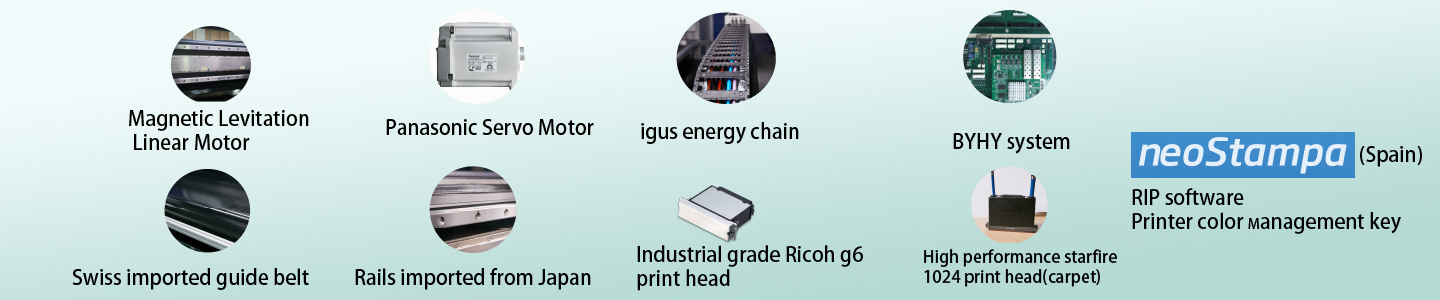
Textile digital printing machines leverage advanced inkjet technology. The process involves pre-treatment of fabrics to ensure ink adhesion, followed by precision inkjet application through the Ricoh G6 heads. The use of magnetic levitation linear motors enhances print accuracy. After printing, post-processing such as heat treatment is applied to fix the inks, ensuring vibrant and durable prints. This process combines efficiency with high-quality output, ideal for diverse textile applications.
These machines are instrumental in sectors like fashion, home textiles, and custom apparel. In fashion, designers can produce intricate designs rapidly to keep up with trends. In home textiles, the capability to print on a variety of fabrics enables production of unique upholstery and decor items. The flexibility of this technology supports the fast fashion industry's need for rapid prototyping and short production runs.
Our factory offers comprehensive after-sales support, including installation assistance, operational training, and ongoing technical support. Our dedicated team ensures your machine operates at peak efficiency, while our global network of service offices facilitates prompt on-site assistance when required.
Machines are securely packaged for international shipment, ensuring they withstand transit conditions. We coordinate with trusted logistics partners to facilitate timely delivery to your facility, with all necessary customs documentation provided.
Our Textile Digital Printing Machine is compatible with a range of materials, including cotton, silk, wool, nylon, and synthetic blends, making it versatile for various textile applications.
Digital printing offers faster setup times, highly detailed design possibilities, and is more environmentally sustainable compared to traditional screen printing methods.
The machine can produce up to 317㎡/h in a 2-pass mode, making it efficient for high-volume production runs.
Regular maintenance includes cleaning the print heads and belts, checking ink levels, and ensuring the software is updated, all of which are supported by our after-sales service team.
Yes, we offer comprehensive training for machine operators to ensure they are proficient in both the operational and safety aspects of the machine.
Absolutely, the digital nature of our printing machine allows for easy customization, enabling unique designs to be printed on demand.
The machine requires a 380VAC power supply and consumes approximately 23KW during operation, with an optional 10KW dryer.
Our machine uses advanced ink degassing systems and precise print head control to maintain superior print quality across all runs.
Digital printing significantly reduces setup time compared to traditional methods; new print jobs can be set up in minutes using the digital interface.
Our after-sales package includes installation support, operator training, and access to our technical support team for troubleshooting and maintenance services.
A recent study highlights how innovations in inkjet technology are advancing the capabilities of Textile Digital Printing Machines, making them more efficient and adaptable to various textiles. This innovation is transforming factory operations, allowing manufacturers to meet diverse customer needs while maintaining high production standards.
With an increasing focus on sustainability, factories are turning to Textile Digital Printing Machines to reduce their environmental footprint. These machines use significantly less water and ink than traditional methods, aligning with eco-friendly manufacturing processes.
Factories are benefitting economically from digital textile printing thanks to reduced wastage, lower setup costs for small runs, and the ability to quickly adapt designs to meet market demands. This flexibility is crucial in the fast-paced textile industry.
Digital printing is revolutionizing the fashion industry by enabling on-demand production and rapid prototyping. Factories can now produce smaller batches of unique designs, supporting the trend of personalization and customization in fashion.
The use of Ricoh G6 print heads is a significant technological advancement in our factory's machines, allowing for high-precision and fast-speed printing, setting a new standard for quality in textile manufacturing.
As factories integrate more advanced Textile Digital Printing Machines, we're seeing a shift toward more agile manufacturing processes, capable of responding swiftly to market trends and consumer preferences.
While digital textile printing offers numerous benefits, factories must address challenges such as maintaining print head quality and managing the learning curve associated with new technologies to fully leverage its potential.
Digital printing technology allows factories to offer unparalleled levels of customization, catering to niche markets and providing tailored solutions to individual customer demands, thereby enhancing competitiveness.
Artificial Intelligence is becoming a driving force in optimizing factory operations, particularly in digital printing, where it aids in predictive maintenance and quality control, resulting in increased efficiency.
Digital printing supports the sustainable fashion movement by minimizing waste and enabling exact ink usage, making factories more eco-friendly and aligning with responsible consumption trends.



Leave Your Message